
The smartphone world doesn’t change often. Most launches feel like minor upgrades wrapped in louder marketing. That’s why the Clicks Communicator is getting attention. It doesn’t try to outgun flagships or win spec-sheet wars. Instead, it brings back something the industry walked away from years ago. A physical keyboard.
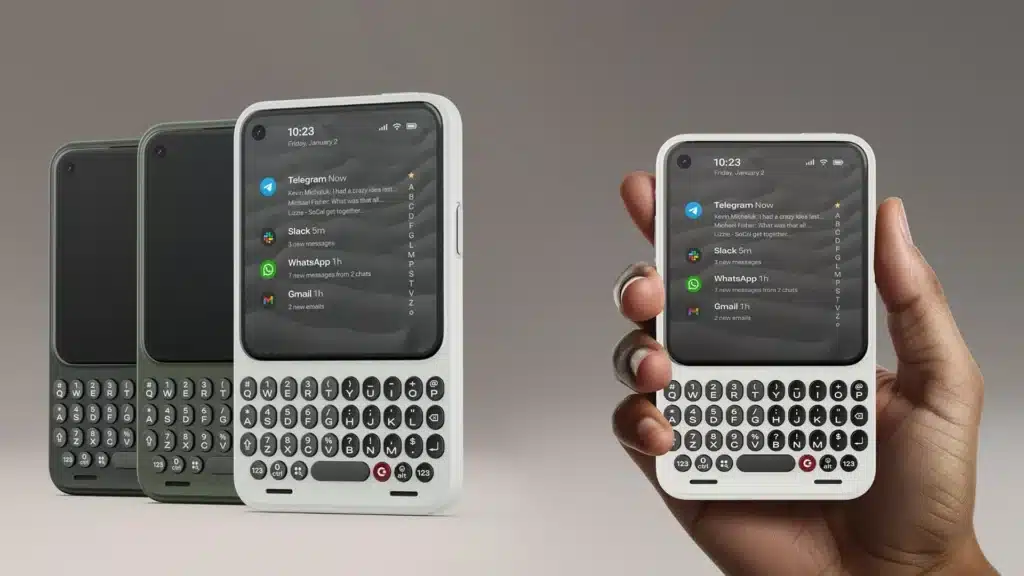
At first glance, the Clicks Communicator looks like a phone pulled straight out of the mid-2000s, but advanced enough to survive in today’s smartphone ecosystem. And honestly, which is enough to make people stop scrolling.
But nostalgia isn’t the whole story.
The Clicks Communicator is an Android phone built around communication, not consumption. The most obvious feature is the full physical QWERTY keyboard baked directly into the device. But the idea goes deeper than just buttons. Clicks position this phone as a focused tool. One meant for typing, messaging, and fast responses instead of endless feeds and notifications.
It’s being pitched as a primary phone for minimalists or a secondary phone for work and intentional use. On paper, it still checks modern boxes with its compact AMOLED display, Android operating system with long-term update promises, and a battery designed to last all day. It carries modern essentials like 5G, NFC, wireless charging, and contactless payments. This isn’t a novelty gadget, but it’s meant to work as a real phone in 2026.
So why is it trending?
Because it’s different in a way people actually care about.
A lot of users never stopped missing real keys. Touch keyboards are fine and fast enough for most people, but they’re not satisfying. Writers, developers, business users, and longtime BlackBerry fans still talk about tactile feedback as if it were taken from them without consent. The Clicks Communicator taps straight into that feeling.
There’s also a bigger shift happening. Distraction fatigue is real. Phones are designed to pull attention, not respect it. The Communicator quietly pushes back on that idea. Fewer distractions. Faster communication. Do the thing, then put the phone down. That message lands a lot harder now than it would have a few years ago.
And then there’s the category itself. Keyboard phones are basically extinct. When something this out of step with the current glass-slab formula shows up, tech communities notice. Even people who would never buy it admit it’s refreshing to see a company try something else.
The community reaction reflects that tension. Some people are genuinely excited. They see productivity, accuracy, shortcuts, and a calmer phone experience. Others are cautious. Early demos used prototype units. Some worry about bulk, comfort during long typing sessions, or whether the keyboard will feel good after the novelty wears off.
Still, the important part isn’t universal praise. It’s engagement. People aren’t ignoring this device. They’re debating it, analyzing it, and arguing about it. For a niche product, that’s a win.
What this launch really shows is that the smartphone industry might have left some users behind. The Clicks Communicator isn’t trying to replace flagship phones. It’s asking a question the market stopped asking a long time ago. What if phones were better at doing things instead of keeping you trapped inside them?
Whether it becomes a cult favorite or stays firmly niche, it proves there’s still room for alternative ideas in mobile tech. Not everyone wants a bigger screen, more apps, or another camera bump. Some people just want to type, respond, and move on.
The Clicks Communicator isn’t for everyone. And that’s exactly the point.
It reminds us that innovation doesn’t always mean adding more. Sometimes it means choosing less, building intentionally, and designing for focus instead of noise. If nothing else, this launch has already succeeded in one rare way. It made the tech world stop and actually look.
And that doesn’t happen often.